
How Much Do Custom Golf Headcovers Cost? Price Factors Explained
Custom golf headcovers cost depends mainly on material, construction, logo method, order quantity and packaging. PU leather driver covers with one embroidered logo sit at the accessible end, while genuine leather, multi-color knit jacquard, custom hardware and gift boxes push unit price up. Larger runs spread setup costs across more pieces, so per-unit price falls as quantity rises.
Key Takeaways
- Material is the biggest single driver: PU leather, knit acrylic and genuine leather each sit in a different price tier.
- Setup items such as embroidery digitizing, knit programming, debossing plates and custom molds are fixed costs that shrink per unit as quantity grows.
- Logo count, logo size and the number of thread or yarn colors add cost faster than most buyers expect.
- Packaging, labeling and freight terms can change your landed cost as much as the headcover itself.
- The fastest way to an accurate number is a quote built on a specific spec sheet, not a generic price list.
Why There Is No Single Price for a Custom Headcover
Buyers often ask for “the price” of a custom driver cover, but a headcover is a small sewn product made from a stack of choices. Outer shell, lining, padding, closure, logo method, color count, labels and packaging all change the bill of materials and the labor time. Two covers that look similar in a photo can differ noticeably in cost because one uses a thicker PU with a fleece lining and a woven brand label, while the other uses a thinner shell with a plain polyester interior.
The useful way to think about cost is in layers. First there is the base product cost, set by material and construction. Then there are decoration costs, which depend on how many logos you add and how they are applied. Then come one-time setup costs, which are spread across your order quantity. Finally there is everything that happens after production: packaging, inspection, freight and import duties. If you understand each layer, you can steer your spec toward the result you want without overpaying for details your customers will never notice.
If you are still deciding which style to offer, our guide to the best golf headcovers for custom branding compares the main styles and where each one sells best.
Material and Construction: The Biggest Cost Driver
Material choice sets the price tier before any logo is added. Here is how the common options compare for custom programs.
| Headcover type | Typical material | Relative cost | Typical MOQ | Where it fits |
|---|---|---|---|---|
| Driver headcover | PU leather, fleece lining | Moderate | 50 pcs | Pro shops, golf brands, corporate gifts |
| Blade putter cover | PU leather, magnetic closure | Moderate | 50 pcs | Retail, tournament gifts |
| Mallet putter cover | PU leather, magnetic closure, more panels | Moderate to higher | 50 pcs | Retail, premium sets |
| Knit pom-pom headcover | Acrylic knit jacquard | Lower to moderate | 100 pcs | Club merchandise, winter collections, events |
| Fairway and hybrid set | PU leather, numbered tags | Higher per set | 50 sets | Matching sets, private label lines |
PU leather versus genuine leather
PU leather is the workhorse for custom headcovers. It holds embroidery and debossing well, wipes clean, and comes in a wide range of colors and textures. Genuine leather usually costs more, varies more from hide to hide, and needs more careful cutting to avoid flaws. If you want a leather program, ask your supplier about tannery sourcing; the Leather Working Group publishes information on environmental auditing for leather manufacturers that many brands reference in their own sourcing policies.
Knit covers and color count
Knit pom-pom covers are priced differently. The yarn itself is not expensive, but each design requires a knitting program, and every additional yarn color adds complexity on the machine. A two-color stripe with a knitted-in logo is efficient; a five-color pattern with a detailed crest is slower to knit and harder to keep sharp, so it costs more and may need design simplification.
Construction details that add cost
- Lining: plush fleece or faux fur lining costs more than a basic polyester lining.
- Padding: thicker foam gives a premium hand feel but adds material and sewing time.
- Closures: magnetic closures on putter covers cost more than hook-and-loop, and custom-shaped magnets more still.
- Extra panels and piping: contrast piping, two-tone panels and stitched trim add cutting and sewing steps.
- Neck sock: a longer knit or mesh sock on a driver cover adds material and assembly.
Logo Method, Size and Placement
Decoration is the second major cost layer. Each method has a different setup cost and a different per-piece cost.
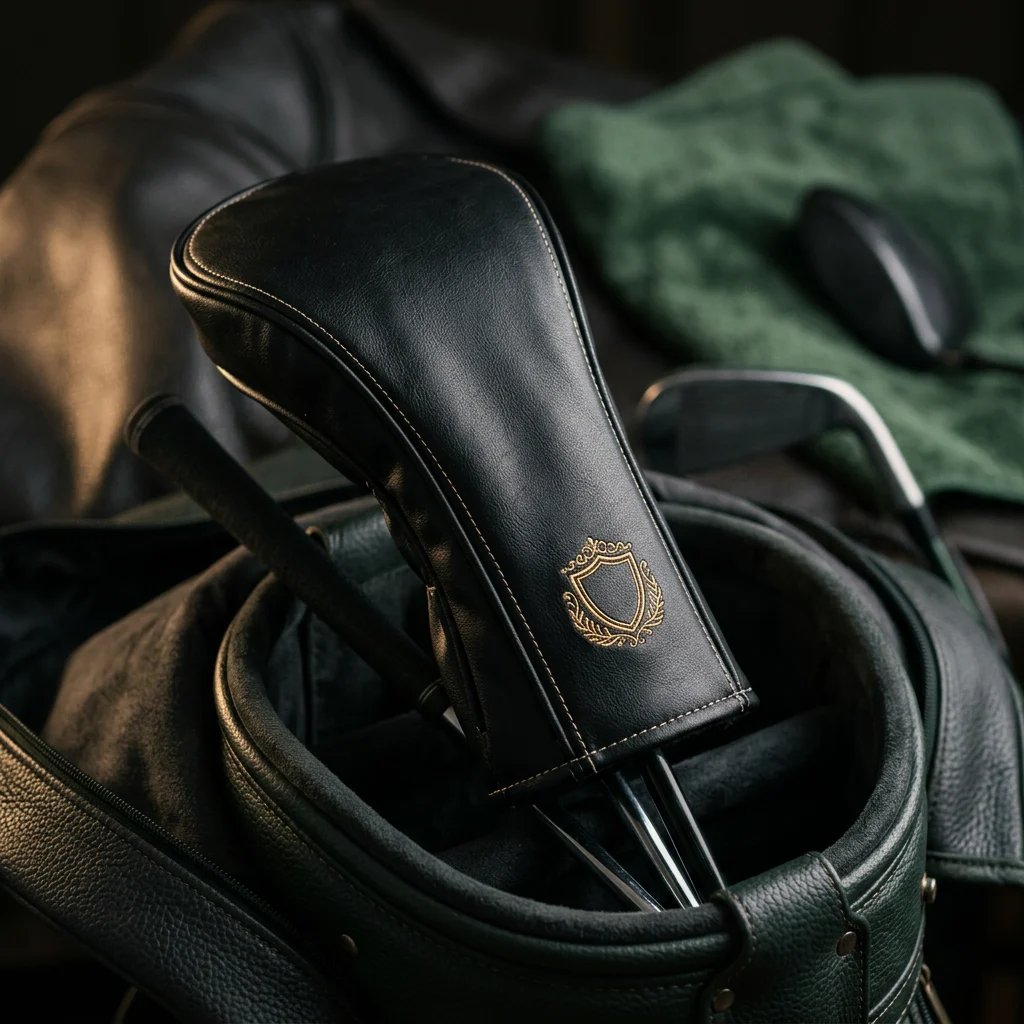
Embroidery is the default for PU leather headcovers. Cost scales with stitch count, so a large, dense logo costs more than a small outline. Each new design needs digitizing, which is a one-time setup. Adding a second or third logo location (for example, a brand mark on the front and a club logo on the side) multiplies the embroidery time.
Debossing and embossing require a metal plate or die, a one-time cost. After that, per-piece cost is low, which makes it efficient for clean, single-color marks on larger runs.
Woven labels and patches are produced separately and sewn on. They allow fine detail and many colors, but add a component and a sewing step.
Knitted-in logos on pom-pom covers are part of the knitting program, so they carry no separate decoration charge, but detail is limited by the knit gauge.
Color matching affects cost too. Matching thread or yarn to a brand color is normally done against a Pantone reference. Most standard shades are easy to hit; unusual colors may need a custom dye lot, which can raise cost and minimums for that component.
How Order Quantity Changes Unit Price
Quantity is where buyers can make the biggest difference to unit price. Every custom headcover order carries fixed work that does not change with volume: digitizing or knit programming, plate making, pattern adjustments, sample making and line setup. On a 50-piece order, that fixed work is shared by 50 units. On a larger run, the same setup is spread across many more pieces, so the per-unit share drops.
Material purchasing follows the same logic. Small orders often use stock PU colors and standard linings. Larger orders can justify custom colors, custom hardware or a dedicated dye lot without a big per-unit penalty.
A practical approach is to request quotes at two or three quantity breaks, for example your minimum, a mid-size run and your realistic annual volume. That shows where the price curve flattens and helps you decide whether to place one larger order or several smaller ones. Our MOQ starts at 50 pieces for PU leather driver covers, blade and mallet putter covers, and 50 sets for fairway and hybrid sets; knit pom-pom covers start at 100 pieces. See the full custom headcovers range for current styles.
Get an Accurate Headcover Quote
Send us your logo, preferred style and target quantity. We will reply with a free digital mockup in 1–2 business days and pricing at the quantity breaks you need.
Packaging, Samples and Landed Cost
The factory price is only part of what you pay. Several post-production items can shift your total cost per unit.
- Packaging: an individual polybag is the baseline. Branded hang tags, printed tissue, drawstring dust bags or rigid gift boxes each add cost, and gift boxes can approach the cost of a basic cover.
- Samples: a pre-production sample confirms color, logo size and fit before mass production. Sampling typically takes 5–10 working days and is worth the small extra time on any first order.
- Inspection: pre-shipment inspection based on an AQL sampling plan, such as the method described in ISO 2859-1, adds a modest cost but protects you from receiving a defective batch.
- Freight: headcovers are light but bulky, so carton volume often drives shipping cost more than weight. Express is fast for small orders; sea freight is cheaper per unit for large runs.
- Trade terms and duties: whether you buy EXW, FOB or DDP determines who pays for each leg and for import duties. The ICC Incoterms rules define these responsibilities.
Mass production for headcovers usually runs 12–30 days depending on style and quantity, so build that into your launch calendar along with sampling and transit time.
How to Get a Quote You Can Trust
The quality of a quote depends on the quality of your request. Vague inquiries get vague prices, and those prices tend to change once the details are settled. Give your supplier enough information to price the real product:
- Style and club type (driver, fairway, hybrid, blade or mallet putter)
- Material and color, with Pantone references if you have them
- Logo files in vector format, plus logo size and placement for each location
- Decoration method you prefer, or a request for the supplier’s recommendation
- Quantity breaks you want priced
- Packaging and labeling requirements
- Delivery destination and preferred trade terms
Compare quotes line by line, not just on the bottom number. A lower price can hide a thinner material, a smaller logo or packaging that does not match your request. Our checklist on how to choose a golf accessories manufacturer covers what to verify before you commit. If you are weighing whether to use a factory design or build your own, read OEM vs ODM for golf accessories, because the model you pick affects tooling and setup costs. When your spec is ready, send us your request and we will price it at the quantities you need.
FAQ
What is the minimum order for custom golf headcovers?
Our minimum is 50 pieces for PU leather driver covers, blade putter covers and mallet putter covers, 50 sets for fairway and hybrid sets, and 100 pieces for knit pom-pom headcovers.
Does adding a second logo increase the price?
Yes. Each extra logo location adds decoration time and, for a new design, another setup such as digitizing or a new plate. A small side or back logo costs less than a second large front logo.
Is genuine leather always more expensive than PU leather?
In most cases, yes. Genuine leather costs more as a raw material, varies between hides and needs more careful cutting, while PU leather offers consistent color and texture at a lower cost.
How long does a custom headcover order take?
A free digital mockup takes 1–2 business days, samples typically take 5–10 working days, and mass production usually takes 12–30 days depending on style and quantity, plus shipping time.
Conclusion
Custom golf headcovers cost what their spec dictates: material, construction, decoration, quantity and packaging, plus freight and duties. Start with the style your customers want, keep logos and colors purposeful, request prices at several quantity breaks, and confirm details with a sample. A clear spec sheet is the shortest path to a price that holds from quote to delivery.


