
Debossed vs Embossed Logos on Leather Golf Accessories
Debossed vs embossed comes down to direction: a debossed logo is pressed down into the leather, while an embossed logo is raised above the surface. On leather golf accessories such as scorecard holders and yardage book covers, debossing is the more common choice because it is crisp, durable and works on a single layer of material.
Key Takeaways
- Debossed logos sink into the leather; embossed logos stand up from it.
- Debossing is the standard for scorecard holders, yardage book covers and pouches: clean, durable and economical.
- Embossing usually needs a matched male and female die and often backing support, so it suits thicker, softer materials.
- Blind (no color) deboss reads as understated luxury; adding foil or color fill increases contrast.
- Bold, simple artwork reproduces best in both methods, and fine detail is the most common source of rejected samples.
Debossed vs Embossed: The Core Difference
Both techniques use heat, pressure and a custom metal die to change the surface of a material without printing ink. The difference is the direction of the impression.
- Debossed: the die presses the logo down into the leather, leaving a recessed design below the surrounding surface.
- Embossed: the logo is pushed up from behind, or formed between a matched pair of dies, so it stands above the surrounding surface.
An easy way to remember it: “de” as in down, “em” as in emerging. On the finished product, a debossed logo catches shadow inside the recess; an embossed logo catches light on its raised edges. Both can look premium, but they behave differently in production and in daily use.
Side-by-Side Comparison for Leather Golf Accessories
The table summarizes how the two methods compare on the leather items we produce most often. These are general tendencies; the exact result depends on leather type, thickness and the artwork itself.
| Factor | Debossed | Embossed |
|---|---|---|
| Look | Recessed, shadowed, crisp edges | Raised, dimensional, catches light |
| Tooling | Single heated die | Usually a matched male and female die pair |
| Material needs | Works on a single leather or PU layer | Benefits from thicker, softer leather or padding behind |
| Durability in use | Very good; the recess is protected from rubbing | Good, but raised edges can flatten or wear over time |
| Color options | Blind, foil stamped or color filled | Usually blind; color is harder to keep within raised areas |
| Fine detail | Handles moderate detail well | Detail can soften as material stretches |
| Typical golf items | Scorecard holders, yardage book covers, pouches, headcovers | Padded patches, thick leather tags, premium labels |
Why Debossing Dominates on Scorecard Holders and Yardage Books
Scorecard holders and yardage book covers live in back pockets and bag compartments. They bend, get rubbed against other items and are handled constantly during a round. A debossed logo sits below the surface, so it is protected from that wear. The impression stays sharp after a season of use.
Debossing also works directly on a single layer of leather or PU, which is how these covers are built. There is no need to add padding behind the logo, so the item stays slim enough to fit a pocket. That is why our custom leather scorecard holder and custom yardage book cover are usually decorated with a deboss, either blind or with a foil or color fill.
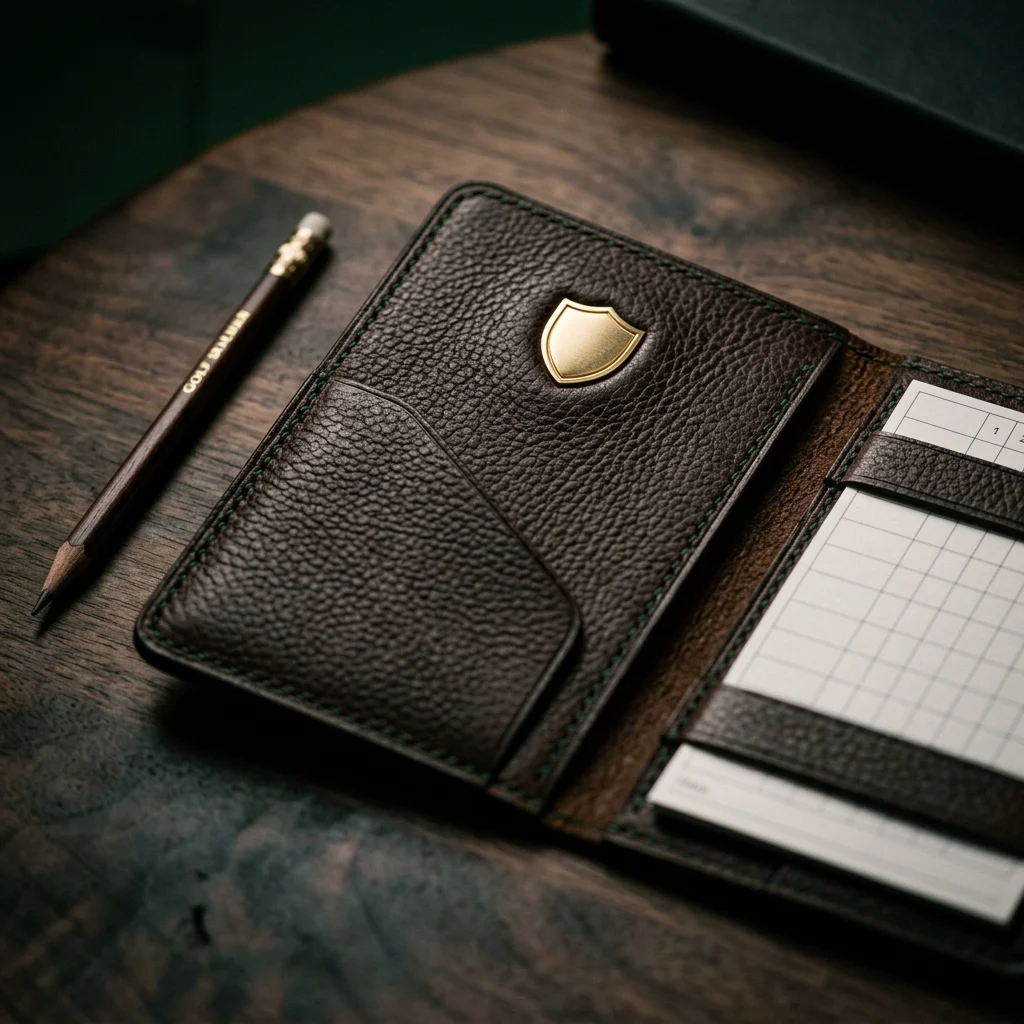
Blind deboss, foil deboss and color fill
Debossing gives you three finishing options:
- Blind deboss: no ink or foil, just the impression. It reads as quiet and premium and suits heritage clubs and luxury brands.
- Foil deboss (hot stamping): a metallic or colored foil is pressed into the recess. Gold and silver are popular for corporate gifts and tournament awards.
- Color fill: ink or paint fills the recess for strong contrast. This works well when brand color matters, and we match against a Pantone reference as closely as the material allows.
Darker leathers usually make blind debossing more subtle, while lighter leathers show the shadow more clearly. If you want the logo to be read from a distance, foil or color fill is the safer choice.
When Embossing Is the Better Choice
Embossing has its place. A raised logo looks dimensional and tactile, which can be striking on a thick leather patch, a padded label or a premium tag. It works best when the material has enough thickness and softness to hold the raised shape, or when a backing layer supports it from behind.
On thin, flat golf accessories, embossing has practical drawbacks. The raised edges take the brunt of rubbing in a pocket or bag and can flatten over time. The matched die pair also adds tooling work. For most of our clients, a deboss gives a cleaner, longer-lasting result on scorecard holders, yardage books and pouches, and we recommend embossing only when the design and material clearly suit it.
See your logo debossed before you order
Send your artwork and choose blind, foil or color fill. We will return a free digital mockup in 1 to 2 business days, and samples typically follow in 5 to 10 working days.
Leather Type and How It Affects the Impression
The material matters as much as the method. Genuine leather and PU leather respond differently to heat and pressure:
- Genuine leather takes a deep, natural-looking impression and can develop character with age. Results vary slightly between hides.
- PU leather gives a very consistent, sharp impression from piece to piece and is easier to keep uniform across a large order.
- Surface finish also matters: smooth finishes show crisp edges, while heavily textured grains can make fine detail harder to read.
For a full comparison of the two materials, including cost, durability and care, see our guide to PU leather vs genuine leather. If responsible sourcing matters to your brand, the Leather Working Group explains how tanneries are assessed on environmental practices; ask us about material options during quoting.
Placement, Tooling and Ordering
On a scorecard holder, the logo usually sits centered on the front cover, sometimes with a smaller mark on the back or inside flap. On a yardage book cover, the front panel is the main position, and some clubs add a hole number grid or initials. Each extra position needs its own die and pressing step, so decide early which positions really matter.
The die is made once from your approved artwork and can be kept for reorders, which keeps repeat orders consistent. Our MOQ is 100 pieces for both scorecard holders and yardage book covers. A typical order runs from free mockup (1 to 2 business days) to sample (usually 5 to 10 working days) to mass production (12 to 30 days, depending on quantity and finish). You can read more about the sampling stage on our samples page.
Artwork Tips for Debossed and Embossed Logos
Because the logo is formed by a die rather than printed, artwork needs to be clean and bold:
- Supply a vector file (AI, EPS, PDF or SVG) with outlined fonts.
- Avoid hairline strokes and very small text; they can fill in or blur.
- Leave enough space between letters and shapes so the leather can form clean walls.
- Use a single-color version of your logo; gradients and shading cannot be reproduced by a die.
- Size the logo to the item: a scorecard holder or yardage book cover has a smaller decoration zone than a pouch.
The same simplified artwork usually works for other decoration methods too. Our guide to embroidery vs patch covers the textile side of a branded program, and our golf valuables pouch guide shows how debossed logos look on pouches. Browse the full range on our bags and pouches category page.
FAQ
What is the difference between debossed and embossed?
A debossed logo is pressed down into the material, creating a recessed design. An embossed logo is raised above the surface. Both use heat, pressure and a custom die rather than ink.
Which is more durable on leather golf accessories?
Debossing is usually more durable on items like scorecard holders and yardage book covers, because the recessed logo is protected from rubbing in pockets and bags, while raised embossed edges can flatten over time.
Can a debossed logo have color?
Yes. A deboss can be left blind with no color, hot stamped with gold, silver or colored foil, or filled with ink for strong contrast. Color fill is matched to a Pantone reference as closely as the material allows.
Does debossing work on PU leather?
Yes. PU leather takes a sharp, consistent deboss, which makes it easy to keep the logo uniform across a large order. Genuine leather also debosses well, with slight natural variation between hides.
Conclusion
In the debossed vs embossed decision, debossing is the practical default for leather golf accessories: it is crisp, protected from wear and works on a single slim layer. Choose blind deboss for understated luxury, foil for a gift-ready finish, or color fill for maximum contrast. Save embossing for thicker materials where a raised logo can hold its shape.


